Cosplay Scope & Planning
Before buying any fabric or cutting an EVA sheet, you need to define exactly what you intend to deliver. Yae Miko is a character with multiple visual layers — the elaborate kimono with floral prints, the voluminous fox ears, the ornamental kitsune mask, and metallic accessories such as the hair ornament and bells. Trying to make everything at once without a clear scope is the fastest way for the budget to explode and the deadline to be lost.
The first step is to define your level of ambition. Do you want a cosplay for contest parades, for a professional photoshoot, or for casual use at events? Each scenario demands different degrees of accuracy in details. For a contest, the kimono modification must be faithful to the character's official references, with clean inner finishing and impeccable hems. For a casual event, you can prioritize visual recognition — that is, the correct silhouette, the right colors, and the striking props like the ears and the mask.
The ideal deadline for this cosplay, considering the kimono modification and the making of the two main props, is between 30 and 45 hours of effective work, distributed over at least three weeks. If you have less time, concentrate efforts on the ears and the mask, which are the most recognizable elements of the character, and simplify the outfit using a purchased kimono with minimal adjustments.
Finally, register your references. Save official images of Yae Miko from different angles, gameplay screenshots, and reference cosplays you admire. A physical or digital reference board (Pinterest, PureRef) is indispensable so you don't waste time searching for images in the middle of construction.

Estimated Budget
| Item | Price range | Source |
| --- | --- | --- |
| Kimono de base para modificação | $30.00 - $70.00 | Estimated FX |
| Chapas de EVA ou Worbla para as orelhas | $12.00 - $36.00 | Estimated FX |
| Máscara base de papel machê ou EVA liso | $3.00 - $10.00 | Estimated FX |
| Tintas acrílicas, spray selador e pinceis | $14.00 - $30.00 | Estimated FX |
| Peruca Yae Miko e acessórios de fixação (grampos, headband) | $20.00 - $50.00 | Estimated FX |
Estimated conversion based on a reference FX rate; local retail prices may differ.
Mandatory Materials
- Base kimono — can be a purchased cosplay of the character or a generic Japanese kimono in pink/purple tone
- 2 mm EVA (at least 2 large sheets) or Worbla Finest Art (1 large sheet) for the ears
- White base mask (blank venetian mask or EVA base)
- Acrylic paints: white, hot pink, magenta, gold, black and red
- Matte sealing spray (such as Montana or Acrilex)
- Contact cement (Carpenter or similar) and hot glue gun
- Precision craft knife with replacement blades (Olfa or X-Acto)
- Long pink-lilac wig with the character's characteristic side-swept bangs
- Elastic band (1 cm width) and wig headband
Optional Materials (that raise the result)
- Floral jacquard fabric to replace or overlay kimono details
- Aluminum wire or galvanized 2 mm wire for internal structure of the ears
- Wet-sandpaper grit 400 & 800 for smooth EVA finish
- Primer spray (such as Plasti-Dip) to seal EVA before painting
- Dremel or sander for burrs on props
- Small gold bells for the character's hair ornament

Common Mistakes that Blow the Budget (and How to Avoid Them)
Every cosplayer has already made the mistake of buying too much material, cutting before measuring, or burning a piece while heat-shaping. Below are the most frequent mistakes specific to executing Yae Miko, with practical solutions.
Mistake 1: Buying the wrong kimono and discovering it can't be used as a base
Many cosplayers buy a cheap generic kimono without checking sleeve width, hem length, or fabric type. Yae Miko's kimono has wide furisode sleeves with gradient details (pink to purple at the bottom), plus an ornamental obi with a bow at the back. If you buy a simple cotton yukata, the modification will cost more in additional fabric and sewing hours than buying a better base kimono. Solution: Check bust, waist, total length, and sleeve width measurements before buying. Prefer synthetic fabric kimonos with a slight sheen — they are easier to paint and modify.
Mistake 2: Making ears without internal structure and watching them fall at the event
Large fox ears need support. If you just glue two pieces of foam-filled EVA, the weight will cause them to tip forward or sideways after a few hours of wear. Solution: Insert a 2mm aluminum wire inside each ear, securing it to the base that connects to the headband. This allows you to position the ears at the correct angle (slightly tilted outwards and backwards) and keep them stable all day long.
Mistake 3: Painting the mask without sealing the base and seeing the paint peel off
Whether it is papier-mâché or EVA foam, the mask surface needs preparation before receiving acrylic paint. Without primer or sealing, the paint adheres unevenly, smudges, and peels off with handling. Solution: Apply two thin coats of spray primer (or diluted acrylic gesso) to the mask before any color. Sand lightly between coats with 400-grit sandpaper. Only then apply the base colors.
Mistake 4: Ignoring the kimono's fit for your body type
Yae Miko is a tall and slender character. If the kimono is not adjusted to your body, it may have excessive volume at the waist or the wrong hem length, completely breaking the character's silhouette. This is especially relevant for plus-size cosplayers, who need to adapt the proportions without losing visual fidelity. Solution: Make a muslin (prototype in cheap fabric) before cutting the final kimono. Use pins to mark the adjustments and transfer the markings to the final piece.

Where to Invest and Where to Simplify
Not every element of the Yae Miko cosplay requires the same level of attention. Knowing how to prioritize is what separates an impressive result from a blown budget without visual impact.
Invest heavily in the ears. They are the most iconic and recognizable element of the character. Poorly made ears or those with a bad finish immediately draw negative attention. Use quality material (Worbla if the budget allows, or high-density EVA that is well-sanded and sealed), take care with the gradient painting, and ensure the fixation to the head is firm. Crafting anime ears requires patience with the finishing touches — that is where the difference between an amateur and a professional prop lies.
Invest in the wig. Yae Miko's long pink-lilac hair is the frame for the character's face. A cheap wig with opaque fibers and artificial shine destroys the entire composition, no matter how perfect the other elements are. Look for heat-resistant fiber wigs (thermo-activated synthetic fiber) so you can style the ends and side bangs with a flat iron at a low temperature (between 120°C and 140°C).
Simplify the obi details. The ornate sash on Yae Miko's back has an elaborate bow with prints and embroidery. You can reproduce this effect with printed fabric glued onto an EVA or MDF base, instead of embroidering stitch by stitch. The visual result from afar is practically identical and the execution time drops from hours to minutes.
Simplify the metal props. The metal pendants and ornaments on the hair and kimono can be made of EVA painted with metallic gold paint and sealed with glossy varnish. Unless you have experience in jewelry making or metalworking, trying to make these details in real metal is not worth the investment in time and money.
Step-by-Step: Kimono Modification
This step-by-step assumes you already have a base kimono (purchased or handmade) and will modify it to approach Yae Miko's design in Genshin Impact. The modification involves fit adjustment, application of gradient details, and repositioning of decorative elements.
1. Fitting and Marking Adjustments: wear the base kimono with the underwear you will use at the event (including a push-up bra if applicable). Ask someone to mark with pins where the hem should fall (at ankle height, as in the character's design), where the waist should be adjusted, and if the sleeves need alteration. Yae Miko's kimono is more form-fitting than a traditional kimono, so you will likely need to narrow the sides and accentuate the waist.
Checkpoint: After marking, take off the kimono and check that the pins are symmetrical on both sides. Measure with a tape measure: the right and left sides must have the same final width.
2. Sewing Structural Adjustments: with the markings made, unstitch the sides of the kimono on the sewing machine and redo the seams in the new position, using a straight stitch with a 1.5cm margin. If the kimono has a lining, ensure you adjust both layers together to avoid twisting. Do the same on the sleeves if necessary. For the structured drape effect the character has, add an internal hem with lead weights or heavy lead tape (found in curtain sewing stores) at the bottom — this gives the elegant "drop" effect that Yae Miko's design requires.
Checkpoint: Try on the kimono again after each adjustment. The sleeves should allow free movement of the arms and the hem should touch the top of the foot without dragging on the floor.
3. Applying the Floral Gradient: Yae Miko's kimono has a characteristic gradient that goes from light pink at the top to dark purple at the bottom, with overlapping floral prints. Use diluted fabric paint (water-based, such as Acrilex or Createx) to create the gradient effect with a sponge or airbrush. Start from the bottom up, applying the purple color to the hem and gradually moving up. If you don't have an airbrush, use a sea sponge with light dabs, layering thin coats. For the flowers, use a stencil cut from Contact paper or tape mask — position the stencils and apply the pink paint over them with an angled brush.
Checkpoint: Let it dry for 24 hours. Wash a small, inconspicuous area (such as the inner hem) to verify that the ink has set. If it comes off, you need a fabric fixative or heat (iron inside out at the temperature indicated for the fabric).
4. Making and Attaching the Obi: Yae Miko’s obi sash is a wide band (approximately 15cm wide) that wraps around the waist and closes at the back with an ornate bow. Cut a strip of fabric in the correct shade (dark red with gold patterns) that is 15cm wide and long enough to wrap around your waist twice, plus 60cm for the bow. Reinforce it with fusible interfacing to provide structure. Sew one side of the sash to the kimono (at waist height, on the inside) so it does not slip. The back bow can be a separate piece, made of thin EVA foam covered in fabric, attached with velcro for easy dressing and undressing.
Checkpoint: Put on the complete kimono with the obi. The back bow should be centered and not tilt to either side. Try sitting and standing — the obi should not restrict your breathing.
Step-by-Step: Making EVA Fox Ears
Yae Miko’s fox ears are large, pointed, and slightly curved outward. This tutorial uses EVA foam as the main material because it is accessible and versatile, but the same principles apply to Worbla.
1. Creating the Paper Template: print a full-size front reference of Yae Miko (or scaled to your head size). Draw the outline of an ear on poster board, creating an elongated triangular shape with a slightly rounded tip — her ears are not thin wolf points, they are softer. The ideal height is between 18cm and 22cm depending on your head size. Remember that you need TWO ears, so transfer the template inverted for the second piece. The base of the ear should have a 3cm tab for attachment to the headband.
Checkpoint: Hold the paper templates to your head, positioned where the ears will be. Take a selfie and compare it with the character reference. Adjust the size before cutting the EVA.
2. Cutting and Shaping the EVA Pieces: transfer the template to the 2mm EVA foam sheet using an erasable highlighter. Cut with a sharp craft knife using a metal ruler for the straight sides and following the line freely for the curves. You will need two outer pieces (one for each ear) and two inner pieces (pink inner color, about 1cm smaller than the outer one along the entire contour). To add volume, cut 1cm wide strips of EVA and glue them to the edges between the outer and inner pieces, creating a "wall" that gives thickness to the ear. Use contact cement (shoemaker type) for structural joints and hot glue for filling.
Checkpoint: Assemble a complete ear without glue and press lightly. The structure should maintain its shape without flattening. If it is unstable, add more internal reinforcement strips.
3. Inserting the Wire Internal Structure: cut a piece of 2mm aluminum wire with the length of the ear plus an extra 8cm for the base. Position the wire in the center of the ear, between the two layers of EVA, bending it to give the slightly arched shape of Yae Miko’s ears. Secure with hot glue at several points along the wire, ensuring it does not move. The extra 8cm at the base will be folded around the headband, forming the attachment point.
Checkpoint: Hold the ear by the headband and shake it gently. The wire should not slide inside the ear, nor should the tip of the ear flop — if this happens, add more hot glue points around the wire.
4. Sanding, Sealing, and Painting: sand the entire outer surface with 400-grit wet sandpaper to remove irregularities, then 800-grit to smooth it out. Apply two coats of spray primer (Plasti-Dip or acrylic spray gesso) with a 30-minute interval between each. After drying completely (minimum 2 hours), apply the base color with an airbrush or foam brush: white for the outer part and hot pink for the inner part. Create a gradient at the tip of the ears using dark pink or magenta, following the character reference. Finish with a matte sealer spray.
Checkpoint: Gently run your finger over the painted surface. The paint should not mark, come off, or transfer to your finger. If it transfers, apply another coat of sealer.

Step-by-Step: Painting the Kitsune Mask
Yae Miko’s kitsune mask is an iconic accessory that complements the look. It is a white fox mask with red and gold details, featuring narrow eyes and an enigmatic smile. This tutorial assumes you have a smooth white base mask (purchased or made of paper-mâché/EVA).
1. Preparing the Mask Surface: if the mask is paper-mâché, apply two coats of acrylic gesso (or spray primer) with light sanding between each coat. If it is EVA, the process is the same as described in the ears section — spray primer + sanding. The goal is to have a completely smooth and white surface, with no visible porosity. If the base is already white and smooth (like a blank Venetian mask), clean it with isopropyl alcohol to remove grease and dust.
Checkpoint: Run your fingers over the mask. It should be smooth to the touch, with no indentations or visible texture. Hold it against the light — there should be no areas without primer coverage.
2. Design Sketching with Pencil: Using a front-facing reference of Yae Miko’s kitsune mask, sketch the outlines with a soft HB pencil (do not use pen, as the ink may bleed under the paint). Start with the eyes—they are narrow, elongated, and slightly slanted upwards at the outer edges. Then sketch the nose (small and triangular, in the center) and the mouth (a subtle curved line, almost a closed smile). The characteristic red kitsune markings sit above the eyes like stylized eyebrows that extend to the temples.
Checkpoint: Compare your sketch with the full-size reference. Hold the mask to your face and check in the mirror if the proportions are correct in relation to your eyes.
3. Base Color Application: First, paint the red areas using red acrylic (cadmium or scarlet tone) with a fine detail brush (size 0 or 00). The markings above the eyes must be filled in with solid red. The interior of the mask's small ears (if applicable) also gets red. Let it dry completely before proceeding—acrylic paint is dry to the touch in 15 minutes, but requires at least 1 hour for handling without the risk of smearing. For the gold details at the corners of the eyes and on the bridge of the nose, use metallic gold acrylic paint with a liner brush.
Checkpoint: Observe the mask from 30cm away. The edges of the red should be sharp, with no bleeding into the white. If there are irregularities, correct them with white paint using a fine brush.
4. Detailing and Final Finish: With an ultra-fine brush (size 00/0), add the fine details: thin black lines outlining the eyes, small decorative dots on the cheeks (if the reference has them), and any additional ornaments. Yae Miko's mask has a cherry blossom (sakura) detail on one of the cheeks—paint it with five pink petals using the fine brush, with a gold dot in the center. Once everything is dry, apply two coats of matte sealant spray with a 20-minute interval. The matte finish is important to match the character's aesthetic and avoid unwanted reflections in flash photography.
Checkpoint: Hold the mask to your face and take a photo with flash. The surface should not have irregular glares. The colors should be vibrant but not shiny. Also, check the elastic strap—it should be comfortable and keep the mask firm without being too tight.

Final Composition: Putting It All Together
With the three main elements ready (modified kimono, structured ears, and painted mask), the final composition requires attention to the order of dressing and the fastening of each piece. Start with the undergarments and base (bustier, shorts, or skin-toned tights). Put on the kimono, adjust the obi at the waist, and position the sash. Put on the wig and secure it with invisible bobby pins at the nape and sides. Position the headband with the ears under the wig, letting the ears emerge between the strands of hair—this is the most faithful positioning to the character, where the ears seem to emerge naturally from the top of the head. The mask can be worn slid to the side of the head (resting over the left ear, as the character often appears) or on the face for dramatic photos.
Test the mobility of everything together. Raise your arms, sit, crouch, and walk. The ears should not tip over, the kimono should not open in unwanted slits, and the mask should not fall off. If something is unstable, adjust it before the event—never on the spot. The secret to a convincing Genshin Impact Yae Miko is not just in the fidelity of each individual piece, but in the harmony of the complete set in motion. The cosplay mask paint and cosplay sewing come to life when everything works together as a coherent composition.
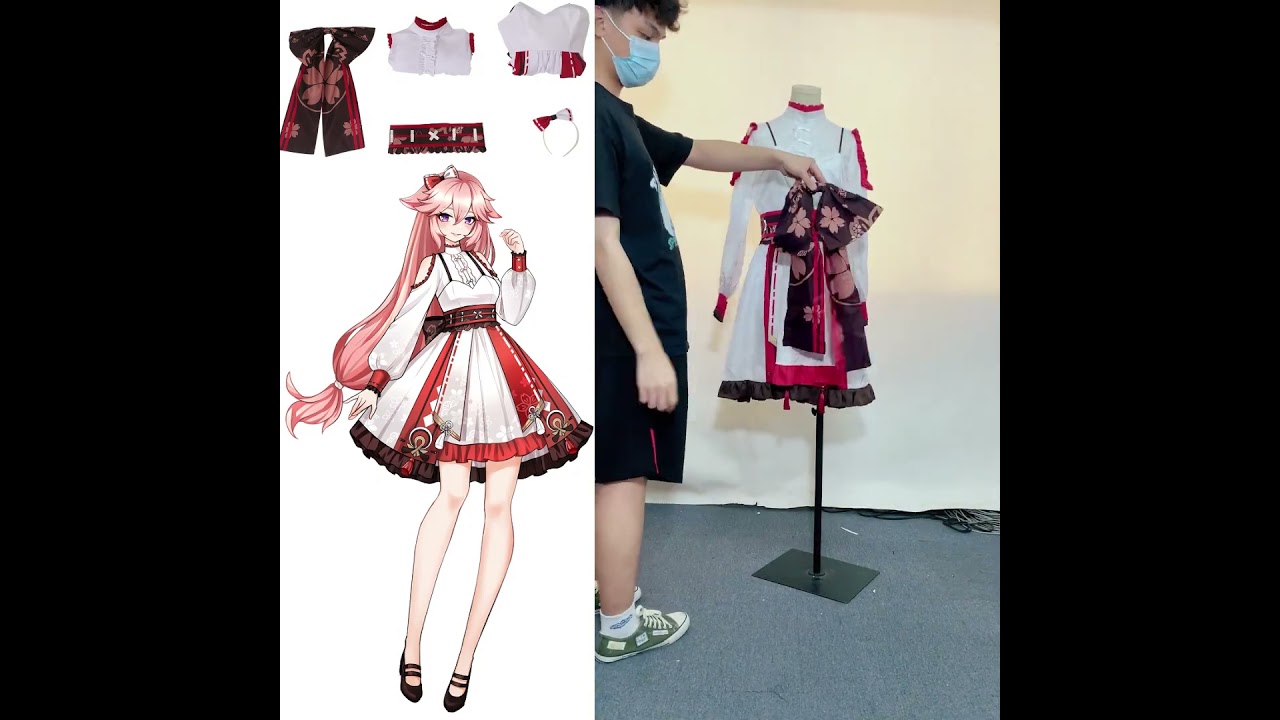
Complementary Genshin accessories—such as the hair ornament with cherry blossoms and the golden bells—can be made of painted EVA foam or purchased separately. They are not mandatory for character recognition, but they add the final polish that makes the cosplay go from "good" to "stunning" in contests and photoshoots. Remember: prop structuring is as much about durability as it is about aesthetics—a prop that breaks in the middle of the event ruins the entire experience.