

1. Choosing the base: density, length and fibre that can handle 1 m of hair
Before dreaming of a braid sweeping the floor, stop and think: 1 metre of synthetic hair weighs a lot, pulls on the scalp and tangles if you just look at it. Picking the ideal Rapunzel wig starts with three numbers: 30″ length, 180 % density and, obligatorily, heat-resistant fibre that survives 150 °C. Anything lower becomes a knotted mess after the first wear.
The cap mesh also matters. Caps with an armature cap — those internal figure-of-eight elastic bands — spread the weight better and prevent the dreaded headache after three hours at the con. If yours only has adjustable straps, sew an 8 mm elastic between the front hooks: you gain an extra 30 % stability.
Finally, colour. Animated Rapunzel sports a slightly ashy golden blonde; live-action versions lean toward honey blonde. Always buy a fibre swatch before investing: store photos distort the shade. If you must customise, use synthetic-fibre dye diluted in isopropyl alcohol and mist with a spray bottle to avoid saturation.
Next step? If the base arrives with too little density (under 180 %), you’ll have to add wefts — which we’ll cover now.
2. Scalp prep: boosting density with sewn-in wefts
30″ wigs usually ship at 140 %–160 % density. For ultra-long cosplay hair worthy of a fairy-tale you need at least 200 %. The cheapest route is to sandwich two packs of 60 cm heat-resistant wefts and sew them in horizontal layers, always a double zig-zag so the machine doesn’t eat the fibre.
Start by flipping the wig inside-out. Mark three rows with tailor’s chalk: 3 cm, 6 cm and 9 cm above the nape. Run the machine on a wide stitch (3 mm) with polyester thread; cotton thread shreds the fibre. Every 15 cm make a double knot — if one stitch snaps mid-con, the rest won’t unravel.
Checkpoint: flip right-side-out and whip up a quick bun; if the cap still shows through the fibres, add one more layer. Remember: the closer to the crown, the thinner the distribution or you’ll end up with a helmet.

3. Anti-yank system: weight-distribution straps and internal elastics
One metre of fibre weighs about 450 g — the same as three bananas on your head. To leave the con without cervical pain, install a wig weight-distribution system. Cut two strips of 2 cm x 25 cm satin ribbon and sew them in an “X” inside the cap, level with the top of the ear. They transfer some tension to the shoulders, not just the scalp.
At the front, sew a small strip of adhesive hook Velcro to the lace edge; on your bio hair (or wig cap) stick the loop. The Velcro stops the fringe from sliding back when you look down — one of the biggest tangling culprits because it drags every fibre to one side.
Finally, dot three drops of non-slip silicone inside the nape. The tacky feel prevents micro-shifts that ruffle the strands and create knots.
4. Active detangling: suspension brushing + silicone spray
Here’s the heart of how to keep a long wig tangle-free: the suspension method. Hook the wig root to a ceiling clothesline with an adapted hanger hook — let it hang 1.5 m off the floor. Pull the fibre downward with one hand while misting a silicone leave-in spray from 20 cm away. Silicone acts as a dry lubricant, cutting friction without greasiness.
Use a wide-plastic-bristle brush (no metal balls on the tips) and always start at the ends, working up 10 cm at a time. When you feel resistance, don’t force it: spray more silicone and wait 30 seconds. Heat-resistant fibre tolerates heat but hates excess tension.
Checkpoint: after brushing 30 cm, release the section; it should fall straight and not coil back. If it still “clown-curls”, add more silicone and let it rest 5 min before continuing.

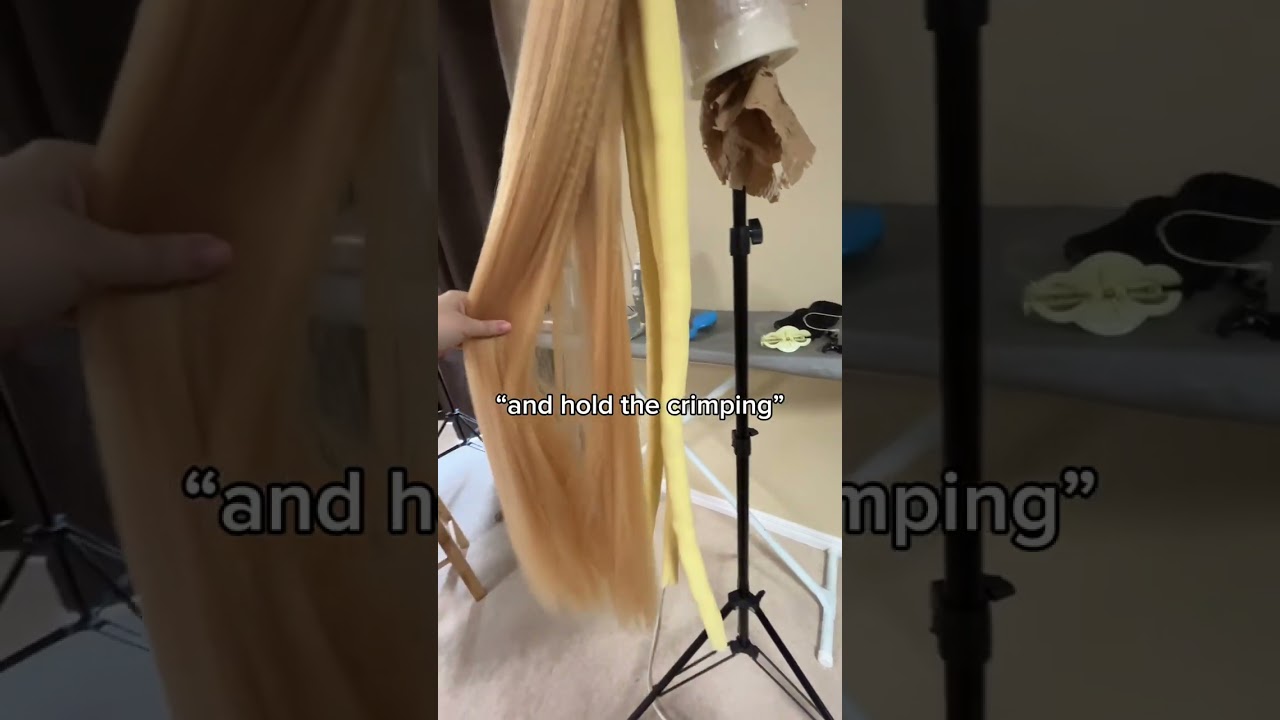
5. Creating the Rapunzel wave: 120 °C “s” waves with a flat iron
The princess’s signature is the “s” wave. Section 3 cm wide x 2 cm thick strands. Work with a ceramic temperature-control flat iron locked at 120 °C — hotter kills shine; cooler won’t set the shape.
Clamp the strand, twist the wrist 180° outward, slide 4 cm, twist 180° inward, repeat to the end. The result is a soft zig-zag like guitar strings. Hold each “segment” for 5 seconds before releasing. While the fibre is still warm, gently tug to lengthen the “s” — this prevents a sausage-curl look.
After waving the whole wig, mist alcohol-free hairspray from 30 cm and let it cool 10 min. The spray forms a film that keeps the shape even after packing.
6. Building the classic braid (without losing volume)
Rapunzel’s braid is loose but massive; wrapping everything into one rope compresses the waves into a sausage. The secret is a loose outside braid using four strands: three regular ones plus a fourth “dummy” weft in the centre that adds body without weight.
Start by dividing the hair into front (brick-lay) and back sections. Clip the top and Dutch-braid to shoulder length, then switch to a classic braid. Every three crosses, release 1 cm from the root — this creates the animated “fluffy” effect. Finish with satin ribbon and pin decorative flowers with golden bobby pins (they won’t stain the fiber).
Checkpoint: hang the wig on the hook and pull the braid down; it must keep the visible “s” shape in the escaping waves, without going straight.
7. Transport and on-site maintenance
Folding a 1 m wig is asking for a soap-opera tangle. Coil the braid in a large spiral, secure with a soft elastic and store it inside a draw-string tulle bag — tulle lets it breathe and avoids humidity. Never use regular plastic: it turns into a sauna and kills the waves.
At the hotel or backstage, hang the wig on the door handle with a portable hook. Keep a 50 ml silicone mini-spray in the survival kit: two spritzes and a wide-tooth comb solve 90 % of travel knots. If it rains, take a long-stem umbrella; rainwater + event dust creates sludge that only a full wash at home will undo.
Mandatory vs. optional materials
| Item | Mandatory? | Avg. price (R$) | Cheap alternative |
|---|---|---|---|
| 30″ base wig 180 % heat-resistant | Yes | 200 | 150 % (add wefts) |
| Extra 60 cm wefts (2 packs) | Yes | 50 | Reuse scraps from other wigs |
| Silicone leave-in spray | Yes | 30 | Conditioner diluted 1:4 (test first) |
| Alcohol-free hairspray 300 ml | Yes | 25 | Regular spray (more drying) |
| Satin ribbon 2 m x 2 cm | Yes | 5 | Gift ribbon (wears faster) |
| Decorative flowers 12 pc | No | 20 | DIY crepe-paper flowers |
| 15 ml anti-slip silicone | No | 15 | Double-sided fabric tape |
| 5 kg digital scale | No | 40 | Rent at a hardware store |
| Ceramic flat iron w/ temp. | Yes | 120 | Rent at salon (R$ 20/day) |
Estimated Budget
| Item | Price range | Source |
| --- | --- | --- |
| peruca base 30″ 180 % density heat-resistant | $36.00 - $44.00 | Estimated FX |
| wefts extras 60 cm (2 pacotes) | $8.00 - $12.00 | Estimated FX |
| spray leave-in silicone | $5.00 - $7.00 | Estimated FX |
| laca sem álcool 300 ml | $4.00 - $6.00 | Estimated FX |
| flores decorativas e acessórios | $3.00 - $5.00 | Estimated FX |
Estimated conversion based on a reference FX rate; local retail prices may differ.
Common mistakes & how to fix
-
“I did everything right, but 30 min later my neck hurts”
→ The weight is concentrated on top. Reinstall the satin straps in an “X” and lower the crossing point 1 cm; this shifts the load to the shoulders. -
“The ends turned to straw after flat-ironing”
→ The temp went over 130 °C or stayed on the same strand more than 8 s. Trim the brittle ends, mist leave-in, and next time test at 110 °C first. -
“I transported it in my backpack and it arrived as one big knot”
→ Never fold; always coil in a spiral and secure with a soft elastic. If the knot is already there, hang the wig, spray silicone and use a wide-tooth comb starting from the tips. -
“My braid looks like chewing gum”
→ You pulled the strands too tight while weaving. Go back, lightly mist with water + conditioner (1:1) and release the tension with the brush handle.
Quick summary step-by-step (to print)
- Buy 30″ 180 % heat-resistant base with an adjustable cap.
- Sew extra wefts in double zig-zag on rows 3, 6 and 9 cm from the nape.
- Install “X” satin straps and front Velcro to spread weight.
- Hang the wig, mist silicone and brush from the tips up.
- Curl 3 cm strands with flat iron at 120 °C in an “s” pattern.
- Dutch-braid + dummy yarn, releasing 1 cm every cross for volume.
- Store coiled inside a tulle bag and carry mini-spray to the con.
Now you have all the secrets to show off a Rapunzel cosplay hair worthy of a fairy tale, without the drama of tangles or the weight of carrying a watermelon on your head. Just follow the steps, invest in the right products and remember the mantra: hang, silicone, release. See you on the next ultra-long-hair adventure!